
Event marketing in Romania: we start from the event day and count backwards
Promoting an event in Romania is a countdown from the day itself: what we say, to whom and when. Pick your date and see the 8-week calendar.
What we did, exactly
Five event projects, with our part stated on each.
- NEXXT AI SummitThe event website: home page, key numbers, agenda and a footer with a 3D figure. We also handled tracking, GTM, analytics and security. The film is above.
- AGO MediaA 3D virtual lobby for a national medical conference, with entrances to the hall and the stands. See it below.
- Capitala CopiilorA guide to places and events for families in Bucharest, with the event list by date. We built the website ourselves. See it below.
- Tazz x Burger Fest, 2022The public voting page, shown on the festival's LED screen. The voting page was our part.
- Unchain Fintech FestivalThe festival website. We coded it, but the design was not ours. The film is below.
Other events we have worked on
- Beach Please
What we can show, and what we cannot yet
We can show projects. We have no ticket sales or attendance figures from these events to publish. The calendar below is how we work, not a result we achieved.
A festival website, coded by us
Unchain Fintech Festival: the home page with the festival film inside a neon fortress frame, then the map of routes from Central and Eastern Europe. We coded the website. The design was not made by us, so we do not present it as design work.
Event promotion in 8 weeks: from the first signal to the event day
Each week has one job and one number to watch. In the first two, people are just finding out the event exists. In the last three, some of them want to buy but still have an unanswered question.
A planning tool. The dates are worked out on this page and nothing is sent anywhere.
Without a date, you see the weeks numbered down to the event.
The date calculator needs JavaScript, which is switched off in your browser. The calendar below still applies: the weeks are counted backwards from the event day, and week 1 is the one right before it.
Signal
People find out the event exists. It is too early to talk about price.
The event page and tracking go live
The page has the date, the venue and a "notify me" form with email and consent. We set up tracking: UTM parameters on every link, page events, ad pixels. We prepare the first two or three teasers: the poster, a short film, a line from the program.
We watch: how many people leave their email and where they come from.
The official announcement, the same on every channel
The date, the venue and the idea of the event in one message, repeated on social media, on the website, by email and with partners. The ticket page goes up as "coming soon" or with the first batch of tickets.
We watch: visits to the ticket page and the waitlist sign-up rate.
Sales
Sales open. Each week gives people a new reason to buy now.
The first wave of the program, and sales to the waitlist
We announce the first artists, guests or speakers. The waitlist gets the ticket link first, before any ads.
We watch: tickets sold from the list and how much of the list bought.
Retargeting and partners
We start ads aimed at people who visited the ticket page and did not buy. Partners and sponsors tell their communities using their own links, so we can see what each one brought.
We watch: checkouts started and tickets sold on each partner link.
The second wave of the program, press, social proof
A second wave of guests, an article or two in niche press, listings in event calendars and material from the last edition: photos, the aftermovie, a real quote from an attendee.
We watch: visits from press and calendars, compared with those from ads.
Pressure
Whoever has not bought yet usually has a question. We deal with it.
The full program, and answers to the repeated questions
We publish the whole program. We put the answers to what people ask on the ticket page: how to get there, where to park, what the ticket includes. We also go to groups: companies, schools, communities.
We watch: the questions that arrive by message and email, so we can move them onto the page.
People who started paying and did not finish
Ads and short messages for people who started a checkout. Messages by email, SMS or WhatsApp go only to people who gave their consent. "Last tickets" appears only if it is true.
We watch: how many of those who started paying complete it.
Event week
We send the program, the access details and what attendees need to bring. We prepare the content for the event day: who films, what gets posted, at what time.
We watch: sales by day, to see whether the reminder message moved anything.
The day and after
On the event day: entry with scanned tickets, a QR code to content and a survey, live content on social media, partners mentioned, contacts collected only with consent.
In the week after: a thank-you to attendees, a gallery, the aftermovie, a three-question survey, the list for the next edition and the final report: which channel sold, at what cost, and how many of the buyers also showed up.
Channels and retargeting: who sees the ad a second time
A channel either creates demand or closes a sale. Most events need both, in that order.
Creates demand
- Video and photo ads on social media
- They reach people who are not yet looking for the event. We use them from week 8 to week 4, with short films and the program as the subject.We watch: cost per visit to the event page and list sign-ups.
- Partners, sponsors and communities
- Each partner gets its own link with UTM parameters. That is how we know which community brought tickets and which one only shared the post.We watch: tickets on each partner link.
- Niche press and event calendars
- An event calendar has readers who are looking for something to do. A site like Capitala Copiilor, for example, has a button for adding an event.We watch: visits and tickets from each calendar.
Closes the sale
- Google search for the event name
- Anyone who types the event name into Google is close to buying. We keep that search under control: a paid ad on the name and a ticket page that Google can read in full, so the buyer reaches you and not a reseller.We watch: tickets from brand search.
- Email to the waitlist
- The list is made of people who gave their consent. It buys first and cheapest, so we feed it from week 8.We watch: open, click and purchase rates.
- Retargeting
- Ads for people who have already seen the event: the ticket page, half a film, a started checkout. The ladder below shows the order.We watch: the cost of a ticket sold through retargeting.
An event calendar, seen from the inside
Capitala Copiilor is a guide to places and events for families in Bucharest, with the event list by date and with filters. We built the website ourselves. We show it as an example of a place where people look for something to do on their own, not as a sales result.
Retargeting: the audiences, in order of closeness to a ticket
Retargeting means ads aimed at people who have already seen something from us: they opened the event page, started an order or watched half of the film.
The closer the event, the shorter the time window. Pixels fire only with the visitor's consent, and server-side tracking keeps the measurement accurate when some visitors refuse cookies.
- Started payingClosest to a ticket. Ads and messages from the next day.Stops when they buy.
- Visited the ticket pageThey saw the price and left. They get answers to the usual questions: access, program, what the ticket includes.A short window, mostly in the last three weeks.
- Watched half the filmReal interest, no visit yet. They get the program or the guest list.Used from week 5.
- On the waitlistThey gave their email with consent. They get the ticket link first.Uploaded to ad platforms only with consent.
- Already boughtExcluded from sales ads. They get something else: the program, or a friend brought at a discount, if you offer one.Otherwise you pay for ads aimed at people who already bought.
The ticket page: what it holds and what we measure on it
This is where the sale is decided. A visitor should learn what, when, where and how much quickly, then pay in as few steps as possible.
On the first screen
- The date, the start time and the venue
- The price, or a "from" price, with no surprises at checkout
- A single buy button
Further down
- What the ticket includes and what it does not
- The program and how to get there
- Refund terms, contact, frequently asked questions
Payment
- Works on a phone, with card and mobile pay
- Instant confirmation by email
- A ticket with a QR code for entry
Tracking
- Ticket page view
- Checkout started
- Successful payment, with its source (UTM)
Example: on the NEXXT site, the "Get tickets" button sits in the body of the page, under the key numbers, and the main sponsor is in the first image. We build the ticket page ourselves, as part of web development.
How we measure event promotion: which channel sold which ticket
Tracking answers one question: which channel each ticket sold came from. The report starts from the same numbers every week.
| Number | What it shows | When we read it |
|---|---|---|
| Visits to the event page | How much interest the message creates, before any price. | From week 8 |
| List sign-ups | How many people want to know when sales open, with consent. | Weeks 8 to 6 |
| Checkouts started | How many people clicked on a ticket. The gap to successful payments shows where they drop off. | From the sales opening |
| Tickets by source | Which channel, partner and ad brought each ticket, through UTM parameters. | Every week |
| Cost per ticket, by channel | What a ticket cost from ads, from email, from partners. | From week 5 |
| Tickets scanned at the door | How many of the buyers also showed up. | On the event day |
| Contacts collected at the event | The consented list for the next edition. | After the event |
A partner link looks like this: https://example-event.ro/tickets?utm_source=partner-x&utm_medium=referral&utm_campaign=week-5. On the brand activations page there is a generator for links like it.
Festival, conference, sponsors: three different calendars
The same 8 weeks, weighted differently each time. A festival sells in waves, a conference sells to a company, and a sponsor wants to see what it gets.
Festival promotion
A festival is promoted in cycles: the announcement, then the artists in waves, then the passes, then the single days.
- The artist waves. Each wave is a new reason to write to your audience and restart the ads.
- Pass and day ticket. These are two prices and two audiences, so two sets of ads and two landing pages.
- The way there. Lodging, transport and access get their own page, easy to find from the ticket page.
Conference promotion
At a conference, the ticket is often approved by someone other than the attendee. The buyer is a company.
- Speakers and program, early. Each speaker gets a page with their topic, not just a name and a job title.
- The "convince your boss" page. What the attendee learns, what it costs, how the invoice works.
- Packages for companies. Group pricing, a company invoice, a single contact. LinkedIn ads by job title and industry.
The sponsor spot
An organizer sells the sponsor spot more easily when it can tell the brand what it gets.
- Contacts collected with consent, sent to the brand's CRM.
- Content from the stand and a game leaderboard, with prizes.
- QR code and UTM tracking, on every material.
The full description, with a game to try, is on the page the brand reads.
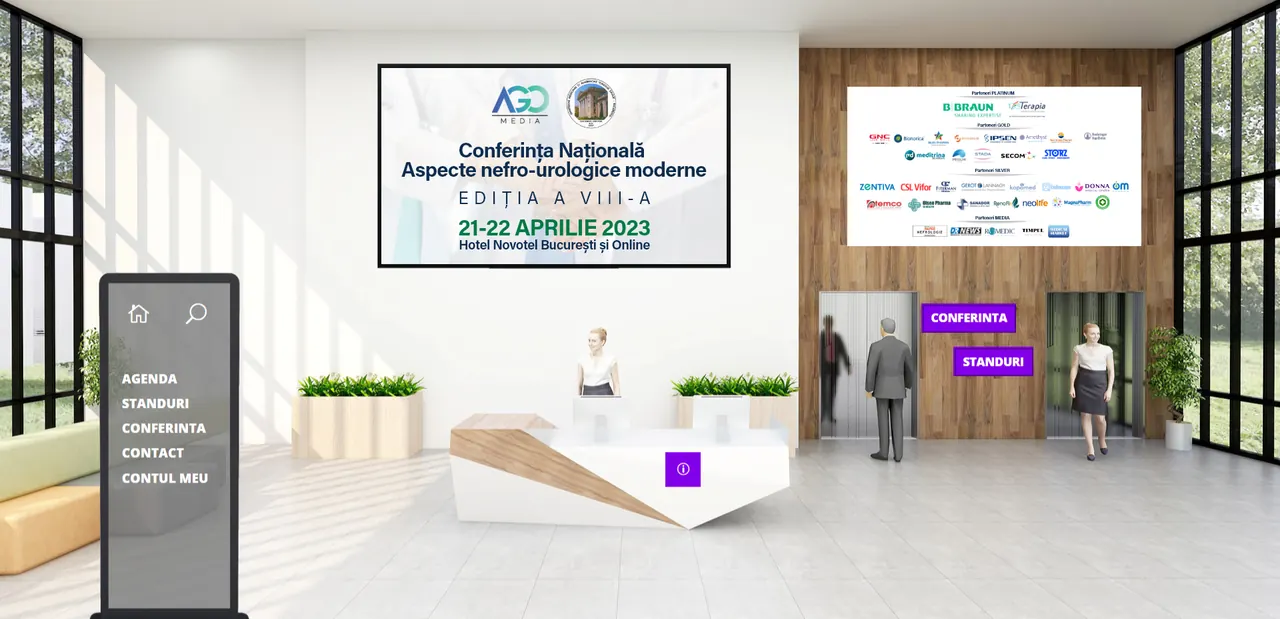
A conference lobby, seen from the inside
AGO Media: a 3D virtual lobby for a national medical conference, with doors to the hall and to the stands. We built it ourselves.
The quote for an event starts from its date
Tell us the date, the audience and what you want from the event. You get a written quote that says what is in it and what is not.
We do not promise a full house. Our report starts with tickets sold on each channel, not with likes.
Already have a date? Send us what you know and we reply with a calendar adapted to it.
Talk to usWhat organizers ask us
How long before the event should I start promoting it?
Our base calendar is 8 weeks, counted back from the event day. It is not a universal rule: a large festival announces earlier, and a small event can squeeze the first two weeks. If you have fewer than 8 weeks, we do not skip phases, we compress them and start with the event page and tracking.
Which channels are best for promoting an event?
It depends on the phase. Social media ads, partners and niche press create demand in the first weeks. Search for the event name, email to the waitlist and retargeting close the sale. One channel is not enough, and without tracking per channel you cannot tell which one sold.
How do I promote a festival?
In waves. The announcement comes first, then the lineup in stages, then passes and day tickets. Each wave is a new reason to write to your audience and restart the ads. Lodging, transport and access get their own page, and sponsors get a package with what they will collect and measure.
How do I promote a conference?
The buyer is often a company, not the attendee. Publish the program and the speakers early, make a short page the attendee can use to convince their boss, offer group pricing and company invoices, then run ads by job title and industry and send emails to the companies from the last edition.
How do I find out which channel sold tickets?
Every link gets UTM parameters, and the ticket page sends three events: view, checkout started and successful payment. That way we tie each ticket to the channel, partner and ad it came from. The weekly report uses the same numbers, so you can see what changed.
Do you guarantee ticket sales?
No. We do not guarantee tickets sold and we do not promise an attendance figure. We show you what each channel brought, what a ticket cost and what we suggest moving from one week to the next.
How much does event promotion cost?
We do not publish prices for event promotion, because they depend on the date, the audience and the goal. Tell us the date and what you want from the event, and we reply with a written quote that says what it includes and what it does not. The ad budget is paid separately.
What is event marketing, and what does an event marketing agency do?
Event marketing means promoting an event before, during and after it, to sell tickets or to bring in contacts for the participating brands. We work on the marketing side: the website, the ticket page, ads, films and tracking. We do not handle event production, meaning stage, sound or logistics.
Tell us the event date. We tell you what we start with.
Want us to write you, on one page, the calendar adapted to your event? Ask us.